The Pillars of the Apostolic Center Built on the Pattern in Acts 2:42-47
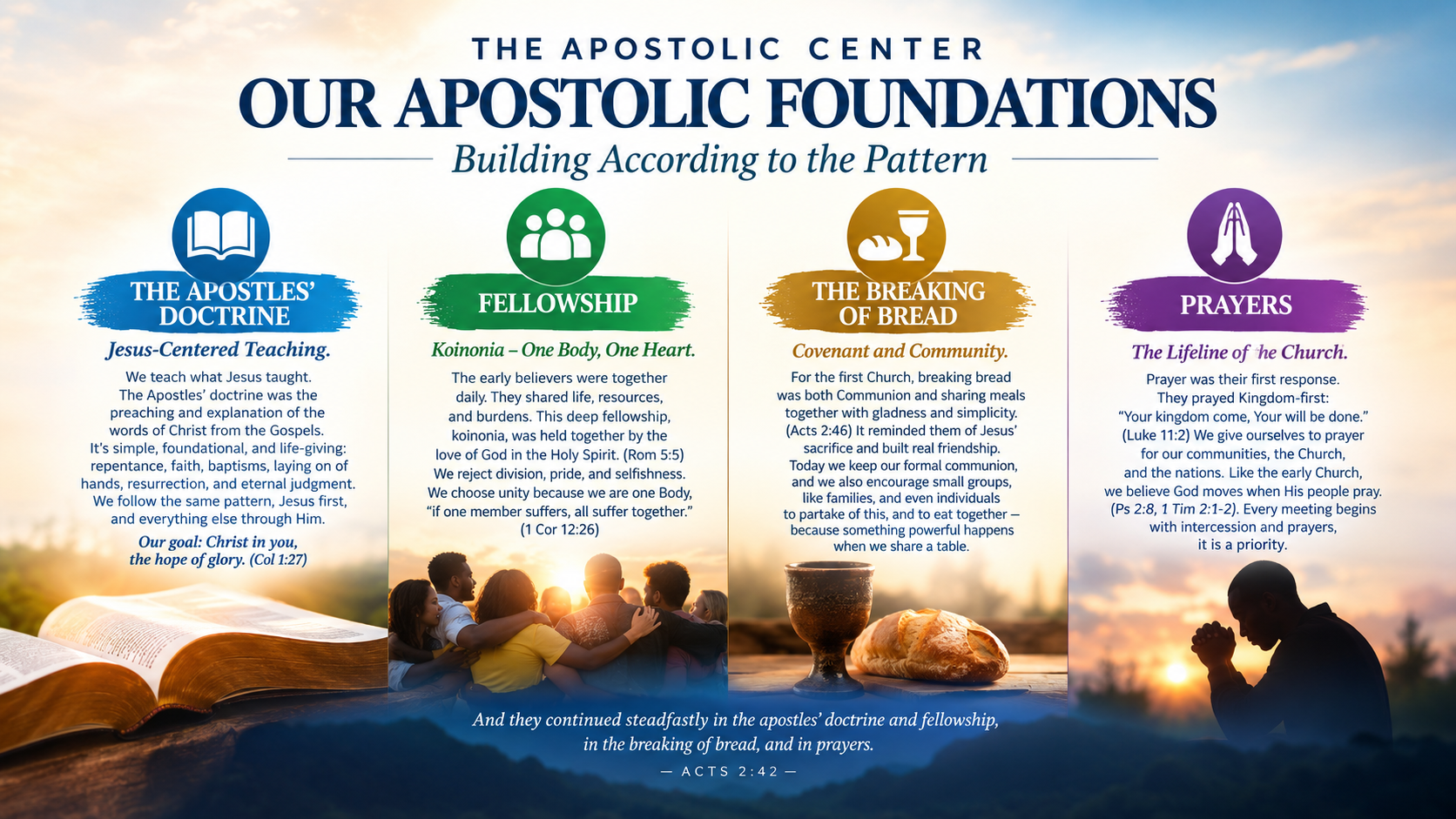
1. THE APOSTLES’ DOCTRINE
Jesus-Centered Teaching
“And they continued steadfastly in the apostles’ doctrine…” — Acts 2:42
The Apostles’ Doctrine is the foundation of our faith and the pattern of teaching established in the early Church. It is not simply a collection of religious teachings or traditions; it is the consistent teaching of Christ and the apostles concerning who Jesus is, what He accomplished, what He taught, and how those who believe in Him are called to live.
At the Apostolic Center, Jesus is at the center of everything we teach. We teach what Jesus taught, and we understand everything else through Him. The apostles did not create a new message disconnected from Christ. They proclaimed, explained, and demonstrated the truth they had received from Him.
A Foundation for Spiritual Growth
The Scriptures identify foundational truths that every believer should understand and build upon. Hebrews 6:1–2 speaks of repentance from dead works, faith toward God, baptisms, the laying on of hands, resurrection from the dead, and eternal judgment.
These truths form part of the spiritual foundation upon which believers are established. We are committed to teaching the Word in a way that is clear, biblical, practical, and transformative.
Our desire is not simply to fill people with information but to produce Christ-like lives.
Jesus First
We believe that the Word of God must always lead us back to Jesus.
Jesus is not merely one subject among many. He is the center, the foundation, and the fulfillment of God’s purpose. Every doctrine, teaching, practice, and spiritual experience must be understood in the light of Christ.
Paul expressed this mystery when he wrote:
“Christ in you, the hope of glory.” — Colossians 1:27
Our goal is therefore not merely to produce knowledgeable Christians, but believers in whom Christ is increasingly formed and revealed.
Transformation Through the Word
The Word of God is intended to transform us. As we encounter Christ through Scripture, our thinking is renewed, our character is shaped, and our lives increasingly reflect Him.
We desire to see believers move from simply knowing the Word to living the Word.
As Paul says:
“But we all, with unveiled face, beholding as in a mirror the glory of the Lord, are being transformed into the same image from glory to glory.” — 2 Corinthians 3:18
Our Commitment
We are committed to returning to a simple, Christ-centered biblical foundation. We will teach Scripture faithfully, uphold the foundational truths of the faith, and continually point believers back to Jesus.
Our desire is simple: Christ revealed, Christ formed, and Christ expressed through His people.
Jesus first. Jesus at the center. Jesus in everything.
2. FELLOWSHIP
Koinonia: One Body, One Heart
“And they continued steadfastly in the apostles’ doctrine and fellowship…” — Acts 2:42
Christianity was never designed to be lived in isolation. From the beginning, the Church was a community of believers who shared more than a common meeting place. They shared their lives, burdens, resources, faith, joys, and responsibilities.
The Greek word koinonia communicates the idea of participation, partnership, communion, and shared life.
At the Apostolic Center, we believe fellowship is an essential part of our apostolic foundation. We are not simply individuals who attend the same meetings. We are one Body in Christ.
One Body, One Heart
The early believers were devoted to one another. Acts 2 shows a community that gathered together, shared life, cared for one another, and remained committed to the things they had received.
Their fellowship was not built around convenience. It was built around Christ and the love of God.
Romans 5:5 reminds us that the love of God has been poured into our hearts through the Holy Spirit. This divine love is what enables us to walk together, forgive one another, serve one another, and carry one another’s burdens.
We Choose Unity
We reject division, pride, competition, and selfishness because these things work against the nature of the Body of Christ.
Instead, we choose humility, love, honour, forgiveness, generosity, and unity.
The Scriptures remind us:
“If one member suffers, all the members suffer with it; or if one member is honored, all the members rejoice with it.” — 1 Corinthians 12:26
When one person is hurting, we care. When one person rejoices, we rejoice. When one person is weak, we strengthen them. When someone falls, we help restore them.
This is the beauty of biblical fellowship.
Sharing Life Together
Fellowship goes beyond Sunday or scheduled meetings. It is about creating genuine relationships where people can know one another, pray together, encourage one another, and grow together.
We encourage meaningful relationships among individuals, families, small groups, and the wider fellowship.
We believe that spiritual growth happens not only when we sit under the Word but also when we walk together in obedience to the Word.
A Community That Reflects Christ
Jesus said:
“By this all will know that you are My disciples, if you have love for one another.” — John 13:35
Our fellowship should therefore become a visible expression of the love of Christ.
We desire to build a community where people are welcomed, disciples are strengthened, gifts are discovered, burdens are shared, and Christ is seen in the way we relate to one another.
Our Commitment
We are committed to building a fellowship characterized by love, unity, generosity, accountability, and genuine spiritual relationships.
We are not simply building an organization.
We are building a people—one Body, one family, and one heart in Christ.
3. THE BREAKING OF BREAD
Covenant and Community
“So continuing daily with one accord in the temple, and breaking bread from house to house, they ate their food with gladness and simplicity of heart.” — Acts 2:46
The breaking of bread was an important part of the life of the early Church. It carried both a spiritual and communal meaning. The believers remembered the sacrifice of Jesus through Communion, while also sharing ordinary meals and life together.
At the Apostolic Center, we recognize the table as more than a place where food is served. The table can become a place of remembrance, relationship, gratitude, conversation, and community.
Remembering Jesus
When we participate in Communion, we remember the finished work of Jesus Christ.
The bread reminds us of His body given for us, and the cup reminds us of His blood shed for the forgiveness of sins.
Communion points us back to the cross and reminds us that our relationship with God is established through the covenant accomplished by Christ.
We do not approach the breaking of bread as an empty religious ritual. We come with gratitude, faith, reverence, and an awareness of what Jesus has done for us.
Breaking Bread Together
The early believers also broke bread from house to house.
They ate together with gladness and simplicity of heart.
This shows us that fellowship does not always have to happen in formal gatherings. Sometimes deep relationships are built around a simple meal, a conversation at the table, hospitality in a home, or time shared with another believer.
There is something powerful about sitting together.
The Table Builds Community
In a world where people can be increasingly isolated, the shared table provides an opportunity to slow down and connect.
We encourage families, small groups, and individuals to intentionally create opportunities to eat together, welcome others, and share life.
The table can become a place where stories are shared, friendships are formed, burdens are discussed, prayers are offered, and relationships are strengthened.
We believe community grows when people make room for one another.
From Communion to Community
The breaking of bread reminds us that we belong to Christ and to one another.
Paul reminds us that:
“We, though many, are one bread and one body; for we all partake of that one bread.” — 1 Corinthians 10:17
The table therefore points us toward both covenant and community.
We remember Christ, and we remember that we are part of His Body.
Our Commitment
We remain committed to the biblical practice of Communion while also cultivating the wider culture of sharing meals, homes, conversations, and life together.
We want our fellowship to be a place where people do not simply attend meetings but belong to a community.
We break bread to remember Jesus, and we share the table to strengthen community.
4. PRAYERS
The Lifeline of the Church
“These all continued with one accord in prayer…” — Acts 1:14
Prayer was not an occasional activity for the early Church. It was central to their life and mission.
Before major decisions, they prayed. When they faced opposition, they prayed. When they needed direction, they prayed. When people were sick, they prayed. When the Gospel needed to advance, they prayed.
Prayer was their first response—not their last resort.
At the Apostolic Center, we believe the same must be true for us.
Kingdom-First Prayer
Jesus taught His disciples to pray:
“Your kingdom come. Your will be done on earth as it is in heaven.” — Matthew 6:10
Our prayers are therefore not centered only on our personal needs and desires. We pray for God’s Kingdom, God’s purposes, God’s people, and God’s will to be established on the earth.
We bring our families, communities, churches, cities, nations, and the world before God.
Standing in the Place of Intercession
Intercession is standing before God on behalf of others.
We pray for those who cannot pray for themselves. We pray for the salvation of people, the strengthening of believers, the advancement of the Gospel, leaders and nations, families and communities, and the fulfillment of God’s purposes.
Paul instructed believers:
“Therefore I exhort first of all that supplications, prayers, intercessions, and giving of thanks be made for all men.” — 1 Timothy 2:1
Prayer gives us the privilege of participating in what God is doing in the earth.
Prayer as a Priority
We are committed to making prayer a priority in the life of the fellowship.
Every gathering should recognize our dependence on God. We do not want prayer to become a brief opening activity before the “real” programme begins.
Prayer is ministry. Prayer is spiritual work. Prayer is fellowship with God.
We believe God moves when His people pray.
The early Church demonstrated this repeatedly. When they prayed, doors opened, boldness increased, people were strengthened, and the purposes of God advanced.
A Praying People
Our desire is to raise believers who know how to pray—not only during organized meetings but as a lifestyle.
We encourage personal prayer, family prayer, small-group prayer, corporate intercession, and prayer for our communities and nations.
We want prayer to become part of our culture.
Join Us in Prayer
We invite everyone who desires to stand in the place of intercession to join our regular prayer gatherings.
Friday Intercession — 9:00 PM
Submit a Prayer Request
Bring your needs, burdens, thanksgiving, and requests before God. We would be honoured to stand with you in prayer.
Our Commitment
We give ourselves continually to prayer because we recognize that the work of God cannot be sustained by human strength alone.
We pray because we depend on God.
We intercede because we care about His purposes.
We pray because we believe God answers.
A praying Church is a spiritually alive Church.